
My kids and I have really been having a blast discovering brain teasers, puzzles and games from around the world. Last week we tried our hand at this pentalpha puzzle, which I believe has its origins in Crete. (I wasn't able to find any authoritative reference to this, however.)
Pentalpha is part of a category of games known as "placing games." It is played by a single player.

The instructions for playing pentalpha may be a little confusing at first, but as soon as you and your kids understand them, it will seem easy. The brain teasing puzzle itself, however, is deceptively simple. It's not easy!
What you need:
- A game board shaped like a five pointed star with lines connecting each of the triangular sections. Draw a big giant star on a piece of paper and you are good to go.
- Nine counters. Pull these from your other games, or use beans, buttons, coins, etc. The counters do not have to match.
How to Play:
Objective: To place all nine counters on the points of intersection in accordance with the rules.
Rules:
- Place counters one at a time.
- Each counter is placed in three steps. The counter must touch two points before coming to rest on the final, third point.
- The points must be in a straight line.
- The first and third points must be empty. The second point can be empty or occupied.
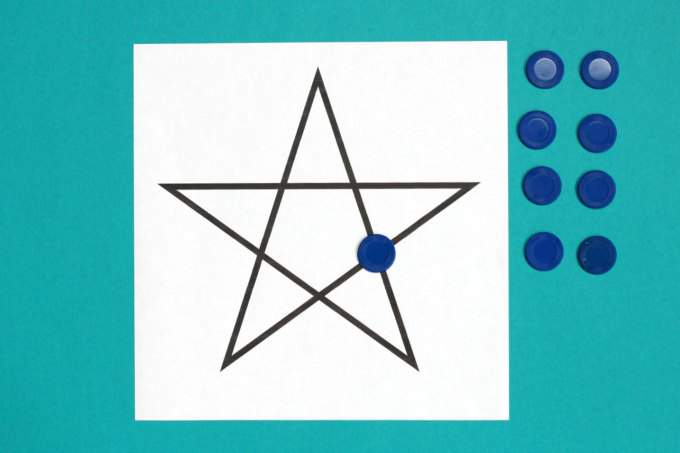
Tip: We found it very helpful to count and use an active verb during the placement of each counter. We said, "START-ONE, JUMP-TWO, PLACE-THREE."
Watch the video:
Need a visual? Watch my pentalpha video. I highly recommend not looking at the solution, but for those of you who simply must do so, the solution is revealed in the video.
More multicultural games and puzzles from around the world:
- Len Choa, a hunt game from Thailand
- Kaooa, another star shaped game! From India
- Fox and Geese, a hunt game from Northern Europe
- Tapatan: a three in a row game from the Philippines.
- Nine Holes: a three in a row game from England
- Pong Hau K'i: a blocking game from China
- Tchuka Ruma: a mancala game from Indonesia
- Peg Solitaire: a brain teaser with versions in almost every corner of the world!

Adrien says
The description of this puzzle is in Murray, A History of Board Games other than Chess, p. 28. It was described to the author by a Miss Sutherland who saw it played in Crete in 1938.
Cheers,
Adrien
Erica says
Thank you so much, Adrien!
Sabin says
Hi, This is a great puzzle, thanks for posting. I have a question about the solution shown above: I cannot place the last two counters according to the rules.
Erica says
Hi Sabin, I think you might be right! It looks like I accidentally used the wrong photos when I made the collage! It's a humbling reminder to always double check everything!! But points to you for being the first person to ever let me know! The solution is in the video, however. The video is above and also here on youtube: https://www.youtube.com/watch?v=ioZYk4z78sc