

One of the best ways you can help your child with reading readiness is to add rhyming activities to their daily life.
Why Rhyme Activities?
Rhymes and rhyming games are a great pre-literacy activity because they help kids understand the phonetic parts of words. Think about those early readers in which a "cat sat on a mat." Children learn to read using basic phonological spelling patterns. If they already understand through listening how those patterns work, so much the better!
I'm not a literacy professional, just a disorganized, yet enthusiastic parent. It's a well-worn phrase, but parents truly are their kids' first teachers and biggest influences on literacy development.
Think of rhymes as brain games for toddlers and preschoolers.
(Note: This post contains affiliate links that may earn commission.)
6 Ways to Incorporated Rhymes in Daily Life
It's very easy to incorporate rhyming into your day with the kids and you don't need any special skills. An excellent side benefit of rhyming is that kids love it and it's a great way to chase the crankies away.
Make It Simple and Random
Adding rhyming fun to everyday life is easy-peasy! (And if my 4 year old was writing this he would add, "lemon-squeezy!") I like to add silly nonsense rhyming to my conversations with the kids.
You probably already do this naturally. If it's time for dinner, I say we're having "pasta-basta!" If it's time to get dressed I say, "Let's put on your socksy-wocksy!" Almost always, he will chime in with his own version.
Spontaneously Recite Nursery Rhymes
Learn a few nursery rhymes by heart and recite them when performing mundane tasks. When I'm cooking at the stove, I love to say "Sausage in a pan, Sausage in a pan, Frizzle-Frazzle, Frizzle-Frazzle, Sausage in a Pan".
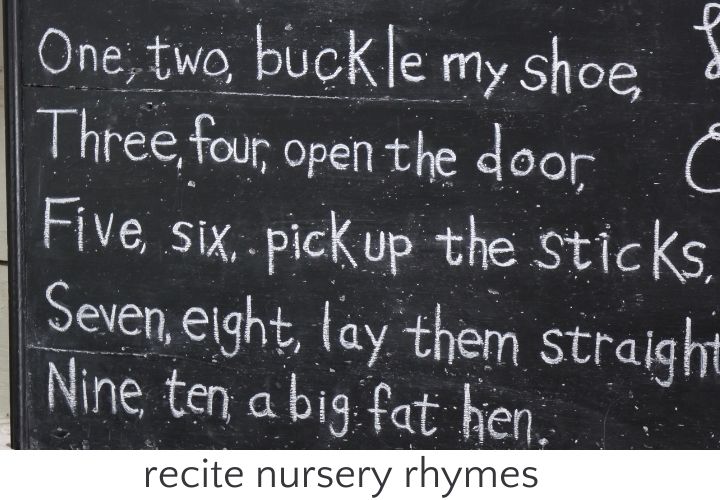
When putting on shoes, the old standby "1, 2, Buckle My Shoe" is perfect. You can be silly with them, too. When my son is counting something and says, "1, 2, 3, 4, 5," I might call out, "I thought I caught a fish alive!" He will them finish the rhyme, "6, 7, 8, 9, 10, but I threw it back again!"
Fill in the Blank
If you've read a rhyming picture book so many times that your child knows it by heart, read it aloud, leaving the last word unsaid so your child can fill in the blank. If this is too advanced for them, instead emphasize rhyming words by using an extra-dramatic voice on the relevant rhyming words.
Turn a Rhyme Upside Down
Unexpected rhyming activities are memorable! Try subverting rhymes. The picture book, Rhyming Dust Bunnies is a perfect example of how this works. Start a string of rhyming words and include a mistake. For example, "red, ted, bed, grass." When I do this, my 4-year-old usually shouts, "no, not "grass!" and then provides his own word to round it out.
Issue Instructions in Rhyme
Include simple, 2 sentence rhymes when you need to take action with the kids. For example, if you are trying to get out the door, say "it's time to go, don't be slow!" Not only does this sneak in some literacy learning, but your kids might just listen to your instructions. (Always a bonus!) In fact, this morning when I did this, both kids made up rhymes during the entire walk to school.
Have a Contest
Kids love this one! Start out with any word and see how many rhyming words you can come up with. For extra giggles, allow invented words.
BONUS: Check out our list of 15 great word games for more ideas!

Jackie Higgins says
I love the upside down rhymes! I'll look for the rhyming dust bunnies. That seems like it takes rhyming to a higher level of thinking. Great tip.
Erica says
It's really fun and always makes my son laugh. You will LOVE Rhyming Dust Bunnies. All of Jan Thomas' books are great for read alouds
Bonnie @ Let's Play Music says
I really love the idea of playing a having a rhyming contest - really get the creativity going! Great post 🙂
E.S. Ivy says
Interesting! I had never connected children's rhyme's being popular with learning to read, but it makes sense.
Erica says
It was a new idea for me, too. When I thought about all those early readers with three letter words, though, I realized, "of course!"
E.S. Ivy says
Oops! I meant "children's rhymes" of course, but there doesn't seem to be an edit comment option. I hit the post button without proofing. 🙂
Erica says
I always do that, too!
Susan Call Hutchison (ReadAloudReadAlong.com) says
No wonder your kids made rhymes all the way to school! They know how fun it is to play with words and sounds. I'm almost 60 years old, and I still think, "Rice is nice," (or even say it aloud) whenever I cook rice, just like my grandma did 55 years ago. Nursery rhymes are BASIC to cultural literacy! Thanks for such a helpful post.
Julie says
Couldn't agree more. In our Julie Logan Music program (0-5 years) in Newcastle, NSW, those same books are absolute favourites for adding a melody. We encourage children to copy the format to create their own 'singing stories' adding rhyming verses, the sillier the better! Chanting children's nursery rhymes supports pre-reading as it provides fun repetition via a beat framework for predictable phrase length. You can enhance your child's responsiveness to instructions by adding a melody - like the tune of I'm the King of the Castle.